When the “Leader–Follower” Experience Opens an Inner Space: The Living Lesson of Abbé Émile NDAYIZIGIYE
On the second day of the Regional Workshop on Peace and Social Cohesion, held
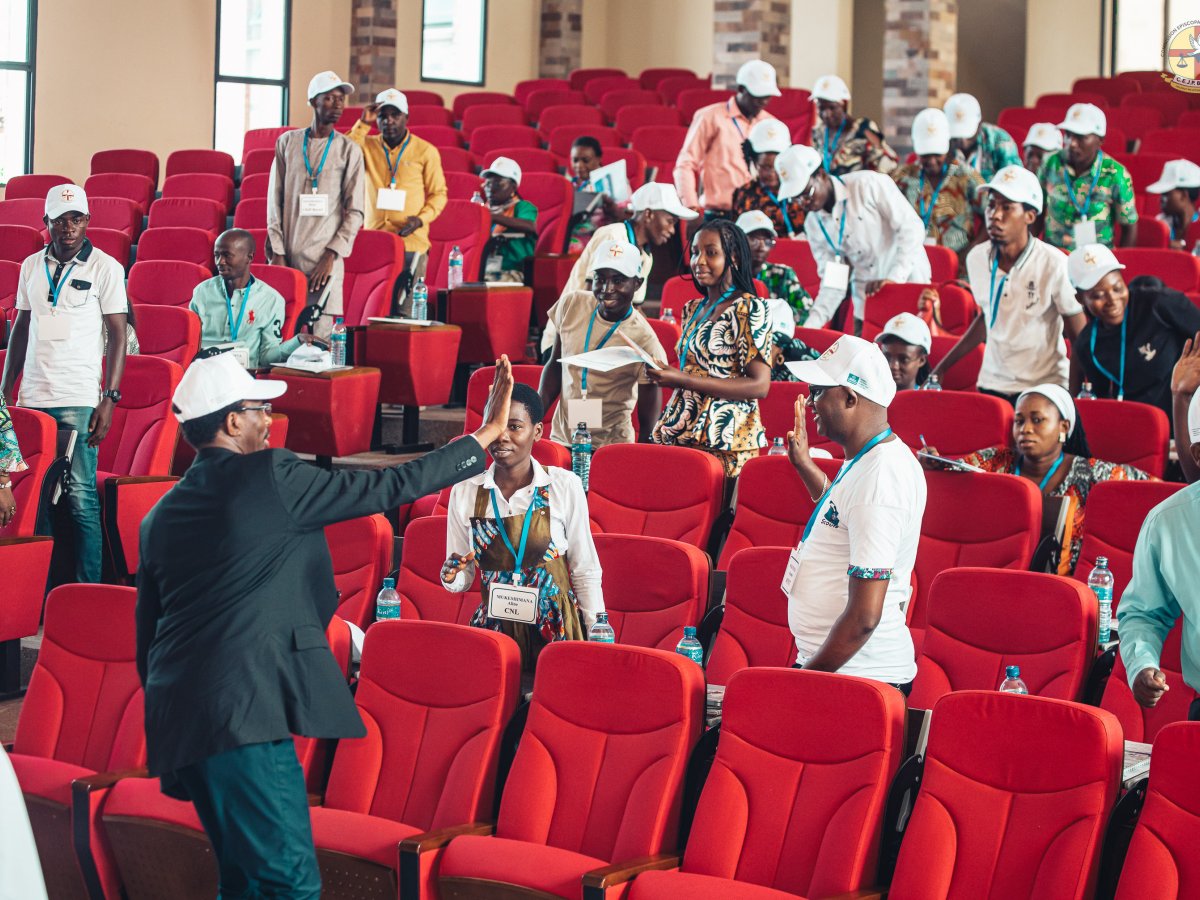
On the second day of the Regional Workshop on Peace and Social Cohesion, held at the Intercultural Center Oasis of Peace and Reconciliation, participants from Burundi, Rwanda, and the Democratic Republic of Congo experienced an extraordinary morning.
A morning in which learning did not take the form of an academic lecture… but rather that of a physical, relational, and deeply human experience.
At the helm was Abbé Émile NDAYIZIGIYE, Executive Secretary of the CEJP, who, with his calm and penetrating style, transformed the room into a space of introspection and collective revelation.
As is customary, the day opened with a time of prayer.
A simple yet essential moment, allowing everyone to settle inwardly and enter the day with an intention of truth and goodwill.
Then, without any apparent transition, Abbé Émile proposed an exercise that seemed harmless at first… but soon revealed itself to be a powerful pedagogical tool.
The principle was simple:
in pairs, one person became the leader, the other the follower.
The leader made movements—sometimes logical, sometimes absurd.
The follower had to follow, without discussion.
Very quickly, the room filled with laughter, hesitation, and puzzled looks.
Some followed mechanically.
Others resisted inwardly.
Still others appeared uncomfortable, as if imitating the other required giving up a part of themselves.
Then, suddenly, Abbé Émile announced:
“Now, we switch roles.”
And the entire room’s energy shifted.
The follower became the leader.
The leader had to follow.
Unexpected reactions emerged:
The exercise ended in an electric, almost cathartic atmosphere.
Everyone had felt something: a bruise to the ego, an inner resistance, a sense of freedom—or frustration.
Faithful to a pedagogy inspired by Socratic maieutics, Abbé Émile imposed no interpretation.
Instead, he allowed the answers to emerge from the participants themselves.
Through a few simple yet disarming questions, he opened a space for reflection:
This questioning acted as a revelation.
It brought to light what each person contributes—sometimes unconsciously—to collective dynamics:
our fears, our habits, our relationship to authority, our way of responding to change.
Abbé Émile then guided the reflection toward a broader reading:
our region bears deep wounds, often linked to toxic forms of leadership or enforced followership.
In our shared histories:
This simple exercise revealed two essential truths:
Leaders are not born.
They become so by learning to listen, observe, and respect.
Followers are not born either.
They sometimes become followers against their will—and it takes courage to learn how to follow without losing oneself.
Abbé Émile’s message was clear:
to build peace, it is not enough to know theories.
One must learn to understand oneself, to welcome the other, to accept the reversal of roles, and to remain dignified both as a follower and as a leader.
It is through these micro-experiences that a lasting culture of peace is born.
This session—and the entire workshop—was made possible thanks to the support of our committed partners:
Their technical and financial support helps create spaces where young people and women become not only beneficiaries, but true protagonists of social transformation.
In reality, that morning was not a simple “game.”
It was an initiation into inner awareness, a way of teaching that:
Peace is not decreed.
It is practiced, felt, and learned.
It begins humbly in relationship with others.
And sometimes, all it takes is a movement, a silence, and a question to open the heart of an entire region.

On the second day of the Regional Workshop on Peace and Social Cohesion, held

Retour sur le discours de Mgr.


Lorem ipsum dolor sit amet, consectetuer adipiscing elit, sed elit diam nonummy ad minim.